


 Churches and Chapels0.3 km ( parking lot by the main road in the direction of Orlické Záhoří) + 0.2 km 0.1 km
4.3 km ;5.2 km Baroque Church of St. Jan Nepomucký is the dominant feature of Vrchní Orlice, an abandoned village after the removal of German residents. It was built between 1708 and 1712 from the original cemetery chapel. Since 2011, extensive reconstruction has been underway and serves as a space for art exhibitions, musical performances and other events.
6.6 km ;8.9 km The first wooden church in Bartošovice existed before 1548. A brick church was built in 1673. The current form of the sanctuary dates from 1731-46. The tower was damaged by lightning in 1793, during the repair it was lowered and given a baroque shaft. At the beginning of the 20th century repaired after a fire caused by another lightning strike, the onion-shaped roofs of the towers were replaced by cone-shaped ones. The altarpiece of the patroness of the church is probably the work of one of Peter Brandl's disciples.
9.5 km ;6.5 km The chapel of the Virgin Mary is located in the settlement of Údolíčko by the road from Rokytnice in Orlické hory to Bartošovice. The chapel was built in 1866 with contributions from the then residents. In 1999-2000, it underwent a general reconstruction, which was mainly financed from the collections of natives now living in Germany and with a significant contribution from the Czech-German Future Fund in Prague. In 2002, a 25 kg bell was installed in the chapel tower.
10.2 km ;14.3 km Late Baroque church from the years 1754–1763, which was preceded by a wooden church, mentioned as early as 1612. The church's furnishings are Baroque-classical, dating from around 1770. The main altar with statues of St. John of Nepomuck, Sigismund, Václav and Vojtěch is an interesting document of the veneration of Czech national saints in the Germanized borderlands.
11.2 km ( Panské Pole parking lot) + 2.5 km 3.2 km It originally stood on a mountain ridge between the villages of Neratov and Horní Rokytnice, where a regular pilgrimage procession took place from the 18th century. Due to the construction of border fortifications, the chapel was to be demolished. However, the local residents decided to save the chapel and in 1937 they dismantled it and moved it in parts and built it again near the settlement of Hadinec, which was founded by the noble family of Nostitz.
12.5 km ( parking lot Mezivrší) + 3.9 km 9.2 km
 It lies on the A. Jirásk mountain road. The chapel was built by loggers who extracted wood for the mines in Kutná Hora. Originally a wooden building from 1671, it was rebuilt in the 19th century. The roof is covered with period shingles, and there is an upland peat bog in the surroundings.
14.1 km ;18.9 km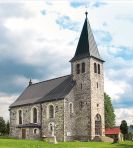
New Romanesque stone church of St. Antonína stands in the Polish village of Lasówka near Divoká Orlice. The village is located right on the border between Poland and the Czech Republic. It was built in 1910 - 1912 from sandstone. The church is a registered protected monument of Poland.
16.7 km ;3.2 km
Baroque cemetery church, built in the first half of the 18th century, completely rebuilt in 1769, renovated in the 1980s and rededicated in 2003. There is a small chapel and an old cemetery near the church.
16.8 km ;9.9 km Parish church on the square built in 1679-84 . Its predecessor was a wooden sanctuary from the 14th century, destroyed by fire in 1661. In the years 1993-99, the church was reconstructed with the help of a number of donors from us, from Germany and Poland. Next to the church stands a memorial to victims of world wars and violence in Rokytnick. The original World War I memorial from 1922 was devastated after 1945. It was reconstructed in 1998. To the right of the main door of the church is a statue of Christ on Mount Olivet. The sandstone statue is from the middle of the 18th century.
17.1 km ;10.2 km The Church of the Holy Trinity was originally built as a Protestant prayer house in 1603 by Mauschwitz. Later rebuilt as a Catholic church. Under the presbytery is the tomb of the noble family Nostitz-Rienek, where 8 nobles of this family are buried. The renaissance tombstone of Joachim Mauschwitz and the sarcophagus of Jan Ignatius of Nostitz are preserved in the presbytery.